
At the onset of World War II, the United Kingdom recognized the need to rapidly expand its armed forces to confront the growing threats posed by Nazi Germany and Japan. The strength of the British Army, Royal Navy, and Royal Air Force underwent significant changes during this tumultuous period. From 1939 to 1945 the UK’s armed forces increased from 480,000 to 5,090,000 personnel. Women armed forces members went from virtually nonexistent to 467,000.
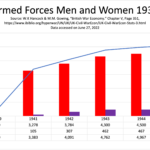
The above graph can be downloaded as an image.
Table of Contents
Prewar and Early-war Mobilization
In the prewar and early-war years, the British armed forces comprised a considerably smaller number of personnel than Germany’s 4.2 million in 1940. The data from W.K Hancock & M.M. Gowing’s “British War Economy” Chapter V, Page 137 provides insight into the evolving numbers of personnel within each service branch. In June 1939, the British armed forces had a combined total of approximately 480,000 personnel. This number included men and women across all service branches. As the war progressed, the need for additional personnel became increasingly evident.
Conscription
The British Army, Royal Navy, and Royal Air Force saw growth in their manpower as the nation prepared for the challenges of the war. Conscription played a pivotal role in bolstering the armed forces. The Military Training Act of 1939 and the National Service (Armed Forces) Act of 1939 provided the legal framework for conscripting eligible men into military service.
Conscription significantly increased the size of the British armed forces, ensuring a steady influx of personnel and enforcing full conscription on all male British subjects between 18 and 41. Additionally, the conscription acts allowed conscription of women although with a far greater number of exceptions than those for men. Such as women who had one or more children 14 years old or younger living with them were exempt from conscription.
By June 1945, as the war entered its final phase, the size of the British armed forces had swelled to approximately 5.1 million personnel. This included both men and women who had answered the call to serve their country.
Women in the Military
One notable aspect of the mobilization effort was the inclusion of women in various military roles. Prewar there were nearly zero women serving in the British Armed Forces and by D-Day, there were nearly half a million.
The Auxiliary Territorial Service (ATS) played a crucial role in this regard, with women serving in a wide range of positions. Princess Elizabeth, the future Queen Elizabeth II, also contributed to the war effort by serving in the ATS. Her involvement exemplified the commitment of the British royal family to the nation’s cause during this critical time.
UK Mobilization versus Other Countries
A comparative analysis of mobilization efforts reveals that Great Britain’s commitment to mobilizing personnel was substantial. When compared to other countries involved in World War II, the United Kingdom’s efforts to recruit and train military personnel were among the most extensive. The scale of mobilization reflected the nation’s determination to defend its interests and contribute to the Allied cause in the global conflict. Both the United Kingdom and the United States mobilized just over 12% of their population into the military. Whereas the USSR mobilized 20% and Germany 26%.
The UK and US strategically decided they would fight a mechanized war. Politically the democratic nations were more sensitive to manpower casualties than either Germany, Japan, or even the Allied partner, the USSR. Therefore, the UK and US ensured that their factories were mobilized to a greater degree.
UK Armed Forces Men and Women 1939-45 Data
To download the data shown below click on the icon below corresponding to you desired format. Note: to ensure all data is downloaded choose the ‘All’ selection in the Show Entries dropdown list. Otherwise only the data visible on the screen will download.
Source: W.K Hancock & M.M. Gowing, “British War Economy.” Chapter V, Page 351, https://www.ibiblio.org/hyperwar/UN/UK/UK-Civil-WarEcon/UK-Civil-WarEcon-Stats-3.html
Other Manpower Data Links
Comparative Military Manpower Sept 1939
Military Manpower by Nation 1940 to 1945
German Armed Forces Manpower by Year
This website, ww2data.com, has no responsibility for the persistence or accuracy of URLs for external or third party internet websites referenced. Nor does ww2data.com guarantee that any content on such websites are accurate or will remain accurate.

Leave a Reply